News & Events
Latest News
MODELAIR Recruitment
**CLOSED** The MODELAIR consortium are currently looking to hire 12 PhD candidates. If you are interested in fluid mechanics, air quality, artificial intelligence and data-driven modeling, among the positions offered in this multi-disciplinary and inter-sectoral PhD program, there is room for those who would like to combine theory with: studying major cities in Europe to reduce pollution, performing computational fluid dynamics numerical simulations and experiments and using data analysis and machine learning tools to build predictive models.
Kick-off meeting
The MODELAIR project kick-off meeting took place on the 18th and 19th of December 2023, in Madrid, serving as a foundational event for both doctoral candidates and leading scientists involved. The gathering provided a platform for participants to get to know eachother. Amidst interactive sessions, attendees gained deeper insights into the project’s structure and overarching objectives. Additionally, a collaborative team activity was organized for the Doctoral Candidates, putting their skills to the test.
MODELAIR, ENCODING and CYPHER!
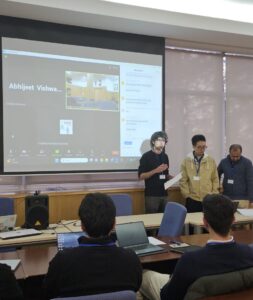
EU-funded projects MODELAIR, ENCODING and CYPHER came together to organise a joint training course at the Polytechnic University of Madrid, from the 3-7th of February 2025.
During the first three days, the participants attended OpenFOAM training delivered by Dr. Chris Greenshields and Dr. Aidan Wimshurst from CFD Direct Limited. This was a practical, implementation-focused CFD training where participants built real simulations, interpreted numerical behavior, and gained operational familiarity with solver construction, turbulence modelling, discretization strategies, and domain-specific setup. The sessions also included dedicated instruction on modelling combustion-related scenarios and urban-flow environments, further strengthening the capability to apply CFD tools to physically complex and industry-relevant problems.
On Thursday and Friday, MODELAIR and ENCODING joined CYPHER to host an extended workshop on machine learning for complex flows. This two-day event featured a full program of invited speaker contributions, methodological presentations, and research-focused discussions. Across both days, the thematic emphasis remained consistent: leveraging machine learning to accelerate CFD execution, enhance inference in sparse-sensor conditions, derive reduced-order representations, integrate physical priors into data-driven solvers, and unify experimental and synthetic data streams. The inclusion of a wide range of academic and industrial research outputs, together with poster exchanges and technical interaction, enabled strong interdisciplinary cross-fertilization between CFD practitioners, fluid mechanicians, and ML researchers.